
Close Critical HR Risks in 60-90 Days: HR Audit Checklist for small businesses
Practical HR audit checklist for small business HR teams. Find compliance gaps, prioritize top risks, assign owners, set deadlines, and track fixes.

An HR audit checklist is a functional, category-by-category tool to find compliance gaps, fix recordkeeping, and prioritize remediation so you can reduce legal risk and operational friction. It walks through employee records, hiring, payroll, policies, safety, and HR systems, then converts what you find into a ranked action plan. The outcome you're working toward: a clear list of gaps sorted by urgency, with an owner and a deadline attached to each.
TL;DR:
- Conduct quarterly sample reviews of employee files and payroll to identify compliance gaps before they become costly issues.
- Prioritize findings into Critical, High, and Important tiers, addressing Critical risks like missing I-9 forms or unpaid overtime within days.
- Focus on high-risk areas such as classification errors, payroll accuracy, and timely benefit documentation to prevent major legal exposure.
- Use specific, documented remediation plans with owners and deadlines to ensure audit findings are resolved effectively.
- Run audits in response to significant events like rapid growth, law changes, or complaints to catch issues early and avoid severe penalties.
Table of Contents
- What Is an HR Audit and Why Should You Run One?
- How Do You Prepare and Scope an HR Audit?
- The Practical HR Audit Checklist by Category
- How Do You Actually Run the Audit and Collect Evidence?
- Turning Findings Into a Real Action Plan
- When Should You Run an HR Audit?
- Using Diagnostics to Turn Audit Findings Into Proof
- How Should You Assess Communication and Engagement?
- What Does a Culture and Diversity Audit Cover?
- How Do You Review Succession Planning and Talent Management?
- Author 'Aaron' on Priorities for Resource-Limited HR Teams
- A Simpler Way to Prove the Problem to Clients
- Where to Go for the Official Rules and Templates
- Sources
What Is an HR Audit and Why Should You Run One?
An HR audit is a structured review of your policies, records, and practices against current legal requirements and internal standards. Think of it as a check engine light for your workforce operations: it won't fix anything by itself, but it tells you exactly where to look before something breaks down in front of a regulator or a jury.
Most audits fall into one of three types. A compliance audit checks whether you're meeting federal, state, and local legal requirements. An operational audit looks at whether your HR processes actually work the way they're supposed to, regardless of legal risk. A strategic audit asks whether your people practices support where the business is headed over the next few years. Comprehensive audit frameworks, including the AIHR structure for HR audits, typically fold compliance and operational checks into a single working audit and treat strategic review as a separate, less frequent exercise.
Running one pays off in ways that go beyond avoiding a lawsuit:
- Reduced legal exposure from wage/hour, classification, or discrimination claims sitting undetected
- Payroll accuracy, since misclassified employees or unpaid overtime tend to compound quietly for years
- Better onboarding and retention, because audits often surface where new hires fall through the cracks
- Cleaner data for decisions, since leadership can't plan headcount or budget around inaccurate HRIS records
The most useful audits sort every finding into three risk tiers: Critical, High, and Important. Critical items are things that expose you to immediate legal or financial penalty (a missing I-9, an unpaid overtime pattern). High items are compliance gaps that haven't caused harm yet but are likely to if left alone. Important items are process weaknesses that hurt efficiency or morale without carrying direct legal risk. This framework, described in CBIA's coverage of HR audit value, matters because it stops you from treating every finding with the same urgency. You'll use it again in the findings section below.
How Do You Prepare and Scope an HR Audit?
A rushed audit produces a pile of documents nobody reads. A scoped one produces a punch list you can act on within a week. Before you open a single personnel file, settle five things.
- Define the objective. Are you auditing because of a complaint, a planned acquisition, rapid headcount growth, or simply because it's been more than a year? The objective determines how deep you go.
- Set the scope. Decide whether this audit covers the whole company or a specific department, location, or risk area (wage/hour only, for example).
- Pick a timeline. A light quarterly check might take two days. A full annual audit across records, payroll, and policy usually needs two to four weeks depending on headcount.
- Choose your reviewers. Internal HR staff know the context but may miss their own blind spots. External reviewers or outside counsel cost more but carry more credibility with leadership and, in litigation, with a court.
- Set confidentiality rules up front. Personnel files, medical records, and compensation data need restricted access during the audit, not just after it.
Once scope is set, request the documents you'll actually need rather than everything that exists. Core items include personnel files, I-9 forms, payroll registers, time and attendance records, the employee handbook, job descriptions, benefits enrollment records, and any prior audit findings that were never closed out.
Assign roles clearly: who pulls records, who reviews them, who owns the final report, and who presents findings to leadership. Build a simple communication plan so managers know an audit is happening and understand it's a process check, not a performance investigation into any one employee.
Pro Tip: Pull your I-9 forms and medical records into physically or digitally separate files before you start anything else. A mixed file is itself a finding, and separating them takes fifteen minutes but removes an entire category of Critical risk before the audit even begins.

The Practical HR Audit Checklist by Category
This is the working list. Go category by category, and mark each item as compliant, needs attention, or missing. Don't try to fix anything yet, just document what you see.
Company-wide governance and people metrics
- Verify headcount, turnover rate, and time-to-fill are tracked consistently across departments
- Confirm an organizational chart exists and matches actual reporting lines
- Check that HR policies are reviewed on a defined schedule, not only when something goes wrong
- Confirm leadership receives HR metrics on a regular cadence, not just at year-end
Employee records
Personnel files are where most audits find their first Critical issue, usually because of mixed storage rather than missing information.
- I-9 forms are stored separately from personnel files, with retention periods honored, a checklist item highlighted in Epstein Becker Green's audit checklist
- Medical records, including FMLA and ADA documentation, live in a separate, access-restricted file
- Access to personnel files is limited to HR and direct-need managers, with a log of who accessed what
- Retention schedules match state requirements, since retention periods vary by document type and jurisdiction
- Terminated employee files are archived per policy rather than deleted or left in active systems
Hiring and onboarding
- Job descriptions exist for every role and reflect actual duties, not outdated templates
- Selection criteria and interview questions are applied consistently across candidates for the same role
- Background checks follow a written, consistently applied policy
- I-9 and right-to-work verification happens within the required window for every new hire, with no exceptions logged
- New-hire paperwork, benefits enrollment, and policy acknowledgments are completed and stored before the employee's first pay cycle
Compensation and payroll
Classification errors are the single most expensive category in most audits, because they compound every pay period they go uncorrected.
- Exempt versus non-exempt classification is reviewed against actual job duties, not job titles
- Independent contractor classifications hold up against current federal and state tests
- Timekeeping records match actual hours worked, with no rounding practices that consistently favor the employer
- Overtime is calculated and paid correctly for all non-exempt staff
- Pay equity across comparable roles has been reviewed at least once in the past year
- Benefits administration matches plan documents, and ERISA-related notices are distributed on schedule
Performance and training
- Performance review cycles happen on the schedule the handbook promises, not sporadically
- Performance improvement plans (PIPs) are documented with specific goals, timelines, and outcomes
- Manager training records exist for topics like harassment prevention, discipline, and leave administration
- Training completion is tracked and refreshed on a defined cycle
Policies and employee handbook
- Handbook includes all legally required notices for every state and locality where you have employees
- State and local addenda exist where laws diverge from federal minimums
- Employees have signed acknowledgment of the current handbook version, not an outdated one
- Policies on leave, discipline, and complaint procedures are written in plain language employees can actually follow
Legal compliance
- Wage and hour practices align with FLSA rules on overtime and minimum wage
- FMLA eligibility, notice, and certification processes are documented per DOL guidance
- EEO complaint intake and investigation procedures exist and are followed, aligned with Title VII requirements
- Accommodation requests under the ADA are logged, tracked, and resolved within a reasonable timeframe
Health and safety
- OSHA injury and illness logs are current and accurately maintained
- Required OSHA postings are displayed at every physical work location
- Incident investigations are documented with root cause and corrective action, not just a report filed and forgotten
- Safety training records exist for roles that legally require them
HR systems and data
- HRIS access is limited by role, with periodic review of who has administrator rights
- Audit trails exist for changes to pay rate, classification, and personal data
- Data retention settings match legal requirements rather than system defaults
- Any AI tools used in hiring or performance decisions have been checked for bias risk and documented use policy
Separations and offboarding
- Final pay is issued within the timeframe required by the applicable state
- Benefits continuation notices (COBRA where applicable) go out on schedule
- Exit interviews happen consistently and findings get reviewed, not just filed
How Do You Actually Run the Audit and Collect Evidence?
Reviewing every file for every employee isn't realistic for most small business teams, and it isn't necessary. Sampling gets you a reliable picture in a fraction of the time.
Pull a full roster and payroll export first, then sample from there rather than reviewing line by line. The University of Oregon's employee record audit process recommends running roster audit reports at least quarterly to catch supervisor and work-location mismatches before they snowball into payroll errors.
Log every finding the same way, every time:
- Document name and identifier
- Reviewer name and date reviewed
- Finding (compliant, gap, missing)
- Risk tier assigned (Critical, High, Important)
A finding without a date and a named reviewer is a finding nobody can act on. Failing to document Critical items properly is part of why noncompliance can escalate to six-figure penalties in extreme cases.
Three concrete techniques worth building into your process:
- I-9 self-audit: pull every I-9 on file, confirm Section 1 was completed by the employee's first day and Section 2 within three business days of hire, and flag any missing reverification dates for expiring work authorization.
- Payroll register reconciliation: compare the payroll register against timekeeping records for a sample pay period, checking overtime calculations and any manual pay adjustments for a documented reason.
- Manager file spot check: pull performance files for two or three managers and confirm PIPs, reviews, and disciplinary notes are dated, signed, and consistent with what the employee's personnel file shows.
Run roster and I-9 exports quarterly at minimum. A full compensation and policy review can wait for the annual cycle, but records and payroll drift fast enough that quarterly light checks catch problems while they're still cheap to fix.
Turning Findings Into a Real Action Plan
A list of problems isn't useful until it's a list of assignments. This is where the risk tiers from earlier do their real work.
- Critical. Immediate legal or financial exposure: missing I-9s, unpaid overtime patterns, active discrimination complaints with no investigation record. These get an owner and a deadline within days, not weeks.
- High. Compliance gaps not yet causing harm but likely to soon: an outdated handbook missing a required state notice, inconsistent classification of a role type. Address within the current quarter.
- Important. Process weaknesses without direct legal exposure: inconsistent review cycles, thin manager training records. Fold into your next planning cycle.
For every finding, use the same remediation template: finding, risk level, owner, deadline, verification method. A finding that says "update handbook" with no owner or date will still be open a year from now. A finding that says "add [state] paid sick leave notice to handbook, High risk, owned by HR Manager, due in three weeks, verified by updated acknowledgment signatures" gets closed.
Pro Tip: Present findings to leadership as a one-page summary sorted by risk tier, not a forty-item spreadsheet. Executives act on the top five Critical and High items far faster than they act on a wall of text, and you can always attach the full detail as backup.
Schedule a follow-up review 60 to 90 days out to confirm Critical and High items actually closed, not just that someone marked them "in progress."
When Should You Run an HR Audit?
Cadence matters as much as thoroughness. A rolling approach works well for most small businesses: quarterly light checks on records and payroll, paired with one comprehensive annual audit covering policy, pay equity, and everything else.
Certain events should trigger an audit outside your regular schedule:
- Rapid headcount growth or a hiring freeze reversal
- A merger, acquisition, or major reorganization
- New state or local employment law taking effect in your jurisdiction
- A formal employee complaint, especially anything touching discrimination or harassment
- A workplace safety incident or near miss
- Turnover spiking in a specific team or role
If a finding touches active litigation risk, a discrimination complaint, or a wage claim already filed, bring in outside counsel before you finalize anything internally. Audit documentation created without legal guidance can sometimes become discoverable evidence in a way that hurts more than it helps.
Using Diagnostics to Turn Audit Findings Into Proof
An audit checklist tells you what's wrong. It doesn't automatically tell a business owner why that matters in terms they'll act on. That gap is where a lot of otherwise solid audit findings die on the desk of a leadership team that doesn't read HR jargon.
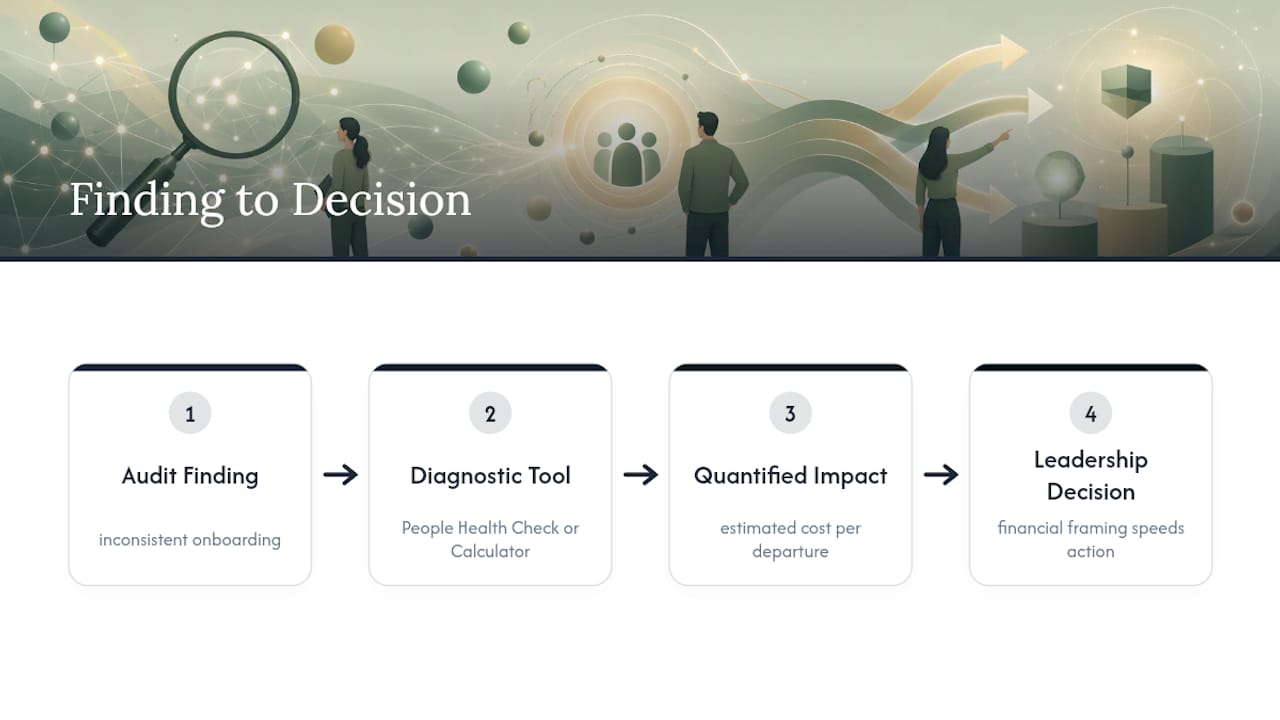
A tool like the People Health Check or a Staff Turnover Cost Calculator converts checklist findings into numbers a business owner reacts to immediately. Turning "inconsistent onboarding" into "your current turnover pattern costs an estimated $X per departure" reframes a compliance conversation into a financial one, which tends to move faster through decision-makers.
For consultants running these audits for clients rather than for their own company, the value of separating the output matters just as much as the diagnostic itself. A client-facing report needs to be plain and jargon-free. A consultant-facing findings report needs the technical detail underneath it. Keeping those two documents distinct, rather than sending clients the same report you use internally, keeps trust intact while still giving you the depth you need to plan remediation work.
How Should You Assess Communication and Engagement?
Audits often stop at paperwork and skip the part employees actually feel day to day: whether communication works and whether people are engaged enough to stay. Add this to your checklist, even briefly.
Start with the basics. Do employees know who to go to with a question, a complaint, or a safety concern? Is there a defined channel for that, or does it depend on who happens to be friendly with a manager that week? A pulse survey covering engagement, wellbeing, and manager effectiveness gives you a baseline you can track quarter over quarter, rather than guessing from anecdote.
Look specifically at manager effectiveness, since it's the single biggest lever on engagement in most organizations. Are managers trained to have difficult conversations, or are they winging it? Do employees report feeling heard, or do they describe a one-way flow of information from leadership down?
Check whether feedback loops actually close. An employee survey that never produces visible change trains people to stop responding honestly, which quietly poisons every future engagement effort. If your last survey results sat in a drawer, that's a finding worth logging just as much as a missing I-9.
Engagement data also feeds directly into your turnover numbers. A team with low engagement scores and rising attrition isn't a coincidence, and pairing the two data points gives leadership a clearer picture than either one alone.
What Does a Culture and Diversity Audit Cover?
Culture is harder to document than payroll, but it shows up in measurable places if you know where to look. A culture and diversity audit checks whether your stated values match what actually happens day to day.
Start with representation data across levels, not just company-wide totals. A workforce that looks diverse in aggregate but shows a steep drop-off in management or leadership roles is a pattern worth flagging, not celebrating.
Review your complaint and investigation history for patterns. Are certain teams or managers generating a disproportionate share of complaints? Are complaints resolved consistently regardless of who filed them or who they were filed against?
Check hiring and promotion data for consistency across demographic groups. This doesn't require sophisticated statistical modeling for most small businesses, just a straightforward comparison of who applies, who gets interviewed, who gets hired, and who gets promoted, sorted by role and department.
Finally, look at whether your anti-discrimination policies are just handbook language or something employees can describe when asked. Training records help here, but so does a simple pulse check: ask a handful of employees in different roles how confident they'd feel reporting a concern. The gap between what leadership believes and what employees actually experience is where most culture audits find their real findings, and it's worth treating those findings with the same rigor as a payroll error.
How Do You Review Succession Planning and Talent Management?
Most small businesses discover their succession planning gap the hard way, when a key employee resigns and nobody has a plan for the role. An audit should catch this before it happens rather than after.
Start by identifying which roles are genuinely critical to operations, not just senior titles. A single specialized technician can be as hard to replace as a department head, and succession planning should reflect actual operational risk rather than the org chart's hierarchy.
For each critical role, check whether there's a documented plan: an internal candidate being developed, a defined skill gap being closed, or at minimum, a realistic estimate of how long a replacement search would take. "We'd figure it out" is not a plan, and an audit should treat it as a finding.
Review whether performance data actually feeds into development conversations. If your performance review process exists but never connects to a development plan or promotion path, you have two disconnected systems pretending to be one, and that disconnect is exactly the kind of Important-tier finding that quietly costs you your best people over time.
Author 'Aaron' on Priorities for Resource-Limited HR Teams
If you're running HR for a small or mid-size business without a full compliance team behind you, don't try to audit everything at once. Start with I-9s, payroll classification, and handbook acknowledgments. Those three categories carry the highest Critical-risk concentration and the fastest fixes once you find a gap.
A diagnostic and template-driven approach beats a blank-page audit every time, mostly because it gives you a structure to fill in rather than a structure to invent. It also gives you something concrete to show a business owner who's skeptical that HR problems are worth budget. Numbers move decisions. A vague warning about "compliance risk" rarely does.
- aaron
A Simpler Way to Prove the Problem to Clients
If you're an independent HR consultant running audits like this for clients, the hardest part usually isn't the checklist. It's getting a prospect to agree they have a problem before you've spent hours building a proposal they might not read. A platform built specifically around that gap exists.
The platform gives branded diagnostics, including a People Health Check and a Staff Turnover Cost Calculator, that a prospect completes in about five minutes on a link carrying the consultant's name and logo, without showing the platform's name. The user receives two reports: one clean and client-ready, the other written for findings work, maintaining a client-facing versus consultant-facing split to aid audit reporting effectiveness. A Companies list, a calendar and a morning reminder email sit alongside the diagnostics to help manage the practice from a single platform.
The platform offers subscription plans with different pricing and client slots, plus a 14-day free trial covering a limited number of clients. Card details may be taken at signup, and billing starts when the trial ends unless cancelled. If you want prospects to see their own numbers before you ever send a proposal, start a free trial with Door Openers and send your first diagnostic this week.
Where to Go for the Official Rules and Templates
- EEOC Title VII guidance for federal anti-discrimination requirements
- DOL FMLA and wage/hour guidance for leave eligibility and pay compliance
- OSHA's official site for safety logs, postings, and incident reporting rules
- University of Oregon's record maintenance and audit process for a practical roster-audit walkthrough
- Epstein Becker Green's HR audit checklist for statutory retention specifics
- Door Openers for consultants who want branded diagnostics tied directly to audit categories like these
Sources
Written by the Door Openers team
Door Openers builds client-winning diagnostics for independent HR and people consultants - health checks, turnover calculators and pulse surveys that go out under the consultant's own brand. We write about the practical side of running an HR consultancy in the UK: opening conversations, scoping work and pricing it.